
How to Make Buttermilk
Make buttermilk for your baked goods with this 5-minute recipe. Combine your milk of choice and vinegar or lemon juice (quantities provided).

Updated by Kathryne Taylor on August 15, 2025
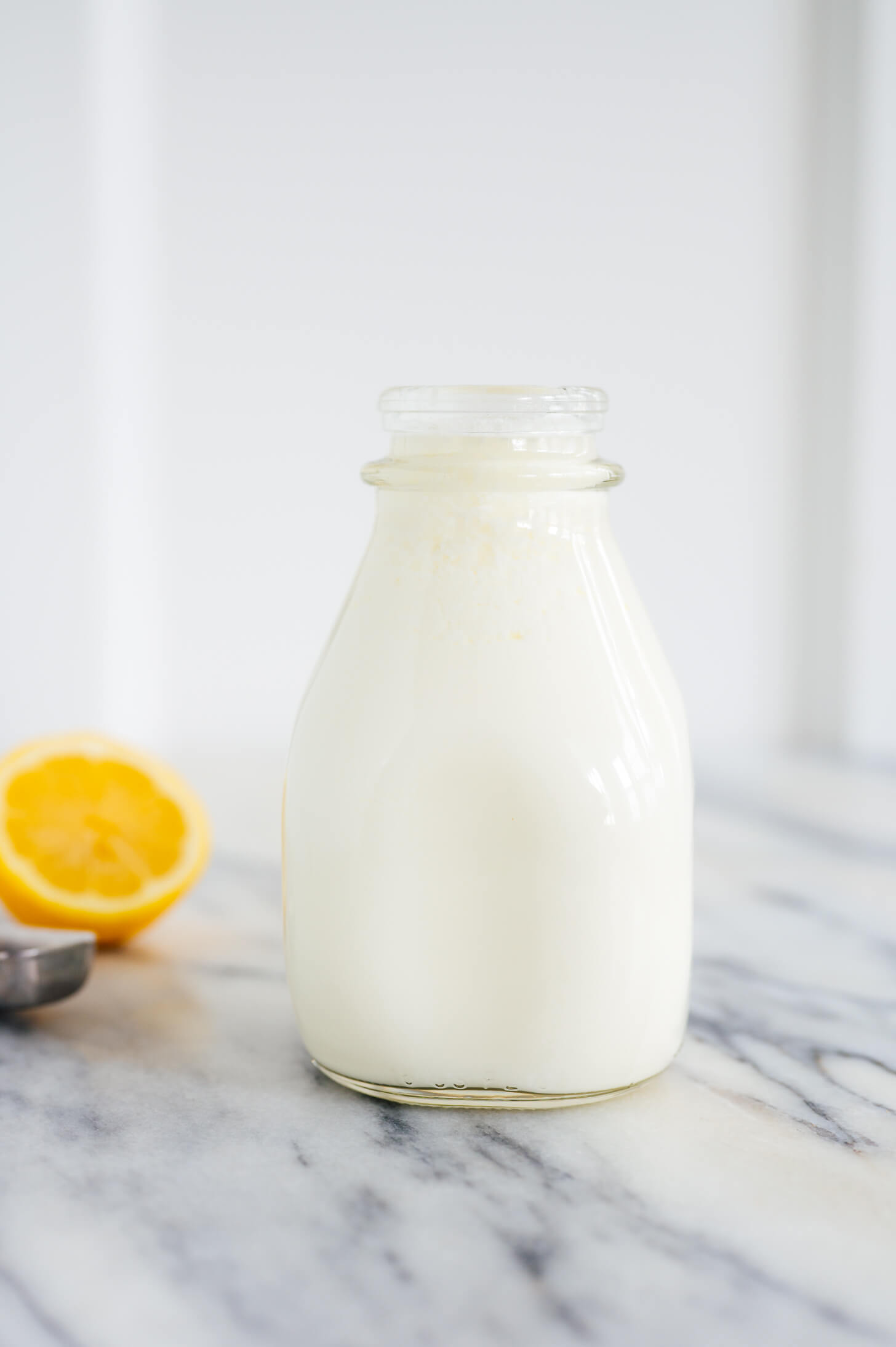
Let’s talk about buttermilk for a minute. Buttermilk in baked goods yields wonderfully fluffy, light and tangy results. You’ve seen me use buttermilk in recipes for muffins, pancakes, waffles and this simple, fruity cake.
So, what is buttermilk? Traditionally, buttermilk was the fermented liquid leftover after churning cream into butter. These days, store-bought buttermilk is typically made from milk with added lactic bacteria, which produce lactic acid.
Contrary to what its name and thickened texture suggest, buttermilk is not buttery and is relatively low in fat. Store-bought options are usually about on par with whole milk, though reduced-fat options exist.
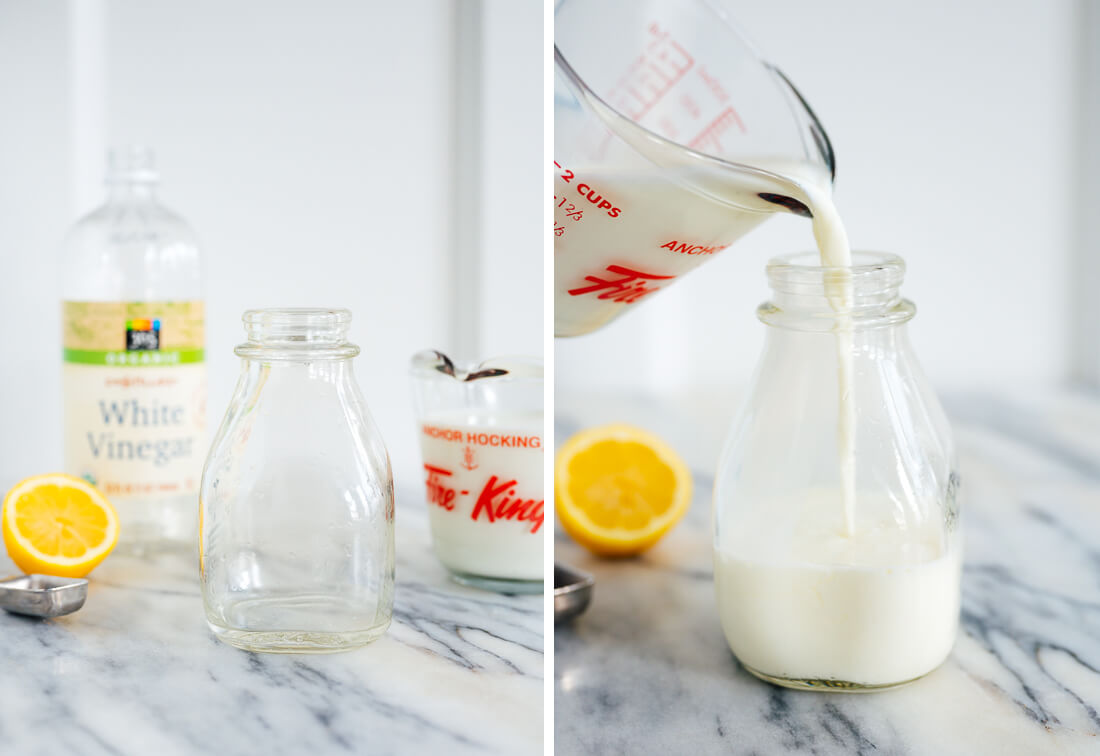
Why do we use buttermilk instead of plain milk? Tangy flavor aside, the acid present in buttermilk helps counteract baking soda, which is basic. Baking soda on its own is quite bitter—it needs both acidity and liquid to taste and function properly.
Buttermilk acts similarly to sour cream or yogurt, which are thicker cultured dairy products. Since buttermilk is thinner, I typically use about two-thirds cup buttermilk in place of one cup sour cream or yogurt.
Homemade Buttermilk Substitute
Today, we’re talking about acidified buttermilk, which is essentially a homemade buttermilk substitute made of milk with added acid (vinegar or lemon juice). This is the perfect substitute for your baking projects when you don’t have buttermilk on hand.
I love this trick because it saves me from buying buttermilk, since I never seem to use up a whole bottle! This method is also convenient if you follow a dairy-free or vegan diet, because you can make buttermilk with any type of milk.
How to Make Buttermilk
Basic buttermilk ratio
1 tablespoon vinegar or lemon juice + 1 cup milk of choice = 1 cup buttermilk
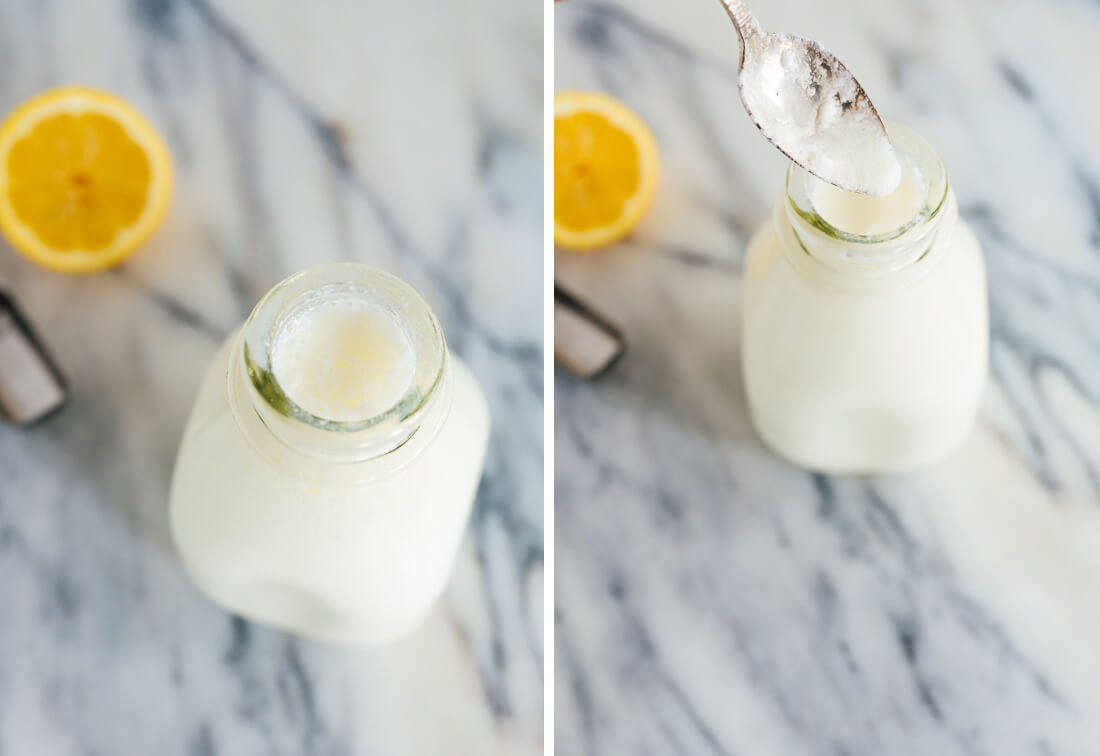
To make buttermilk, simply measure the vinegar or lemon juice into a liquid measuring cup. Pour in milk up to the 1-cup line (so yes, you’ll be using just a tiny bit less than 1 full cup of milk). Stir to combine, and let the mixture rest for at least 5 to 10 minutes before using.
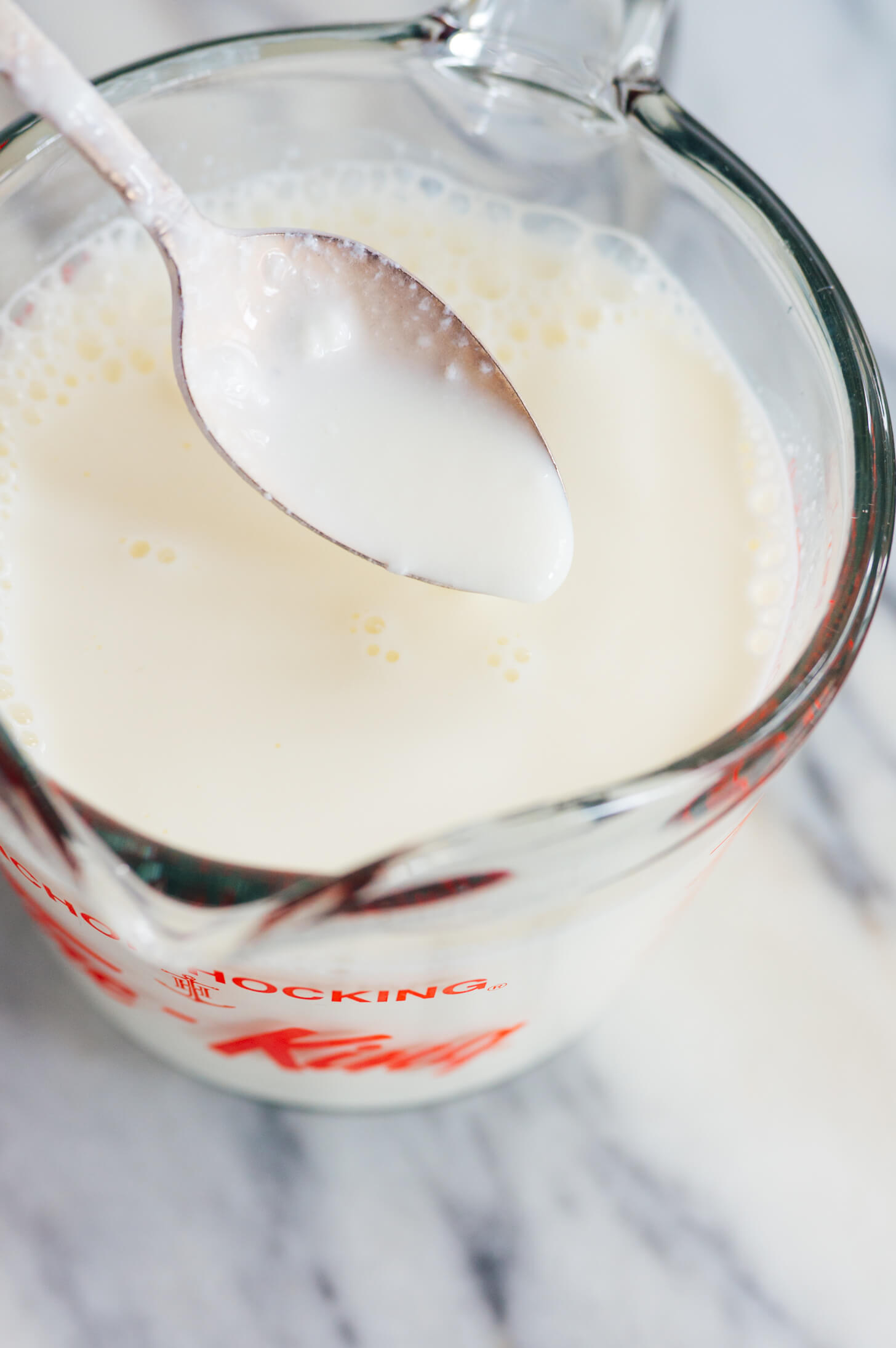
The final consistency should appear somewhat separated at the top with some light curdling. Even if you don’t see a significant change in appearance, the acidity is present, so your buttermilk should work as designed.
Following this ratio, you can make exactly as much buttermilk as you need. Keep in mind that one tablespoon is the equivalent of three teaspoons. Here are some alternate yields for your convenience.
- 1/4 cup buttermilk: 3/4 teaspoon vinegar or lemon juice + 1/4 cup milk of choice
- 1/3 cup buttermilk: 1 teaspoon vinegar or lemon juice + 1/3 cup milk of choice
- 1/2 cup buttermilk: 1 1/2 teaspoons vinegar or lemon juice + 1/2 cup milk of choice
- 2/3 cup buttermilk: 2 teaspoons vinegar or lemon juice + 2/3 cup milk of choice
- 3/4 cup buttermilk: scant 2 1/2 teaspoons vinegar or lemon juice + 3/4 cup milk of choice
Watch How to Make Buttermilk
Recipes Using Buttermilk
- Blueberry Bran Muffins
- Buckwheat Pancakes
- Healthy Zucchini Muffins
- Simple Blueberry Cake
- Whole Wheat Pancakes
More Convenient Baking Components
How to Make Buttermilk
Make buttermilk for your baked goods with this 5-minute recipe. Simply combine your milk of choice and vinegar or lemon juice. You can easily make this buttermilk vegan/dairy free/nut free depending on your choice of milk. Recipe as written yields 1 cup buttermilk. The basic ratio is 1 tablespoon vinegar to 1 cup milk; see post for alternate yields.
Ingredients
- 1 tablespoon vinegar* or lemon juice
- 1 cup milk of choice**
Instructions
- Measure the vinegar or lemon juice into a liquid measuring cup.
- Fill the measuring cup to the 1-cup mark with milk. Stir and let the mixture rest for at least 5 to 10 minutes. You will see some light separation in the milk (curdling). Use as instructed.
Notes
*Vinegar options: Choose from a clear or almost clear vinegar, such as plain distilled white vinegar, apple cider vinegar, rice vinegar or Champagne vinegar. They are all similar enough in acidity levels to work well, and I can’t discern a difference in the final flavor of the baked good depending on which is used.
**Milk options: Choose from cow’s milk, nut milk like almond milk, coconut milk, soy milk, oat milk—any neutral-flavored milk will do!
Make it dairy free/vegan: Choose your favorite non-dairy/vegan milk.
Make it nut free: Be sure to use a milk that is nut free.
Make it soy free: Be sure to use a milk that is soy free.
Nutrition
The information shown is an estimate provided by an online nutrition calculator. It should not be considered a substitute for a professional nutritionist’s advice. See our full nutrition disclosure here.








I love that you included conversions for smaller amounts of buttermilk. I only ever see it for 1 or 2 cups of milk at a time but there’s lots of recipes which only call for a small amount. Can’t wait to see what recipe with buttermilk you’re going to share this week with us!
Thanks, Hayley! Hope this serves as a nice resource. Stay tuned for a blueberry cake. :)
I have made the buttermilk before but it is never as thick as the bought buttermilk so if needed I buy it
Yeah, that’s one of the only downsides. In baked goods, I’m not sure I can ever tell the difference in the end.
the mixture for waffle for example is much more liquidated in compare to bought buttermilk
Hi Kate – You mentioned that you can never use up a full carton/bottle of buttermilk. Me neither, but I’ve discovered it can be frozen. I just put the carton upright in the freezer (clipped closed). (For bottled, you could transfer it to a freezer-safe container.) When I need buttermilk, I put the carton in the fridge a day or two ahead of time to thaw.
Cheers!
Well, that’s great to know! Thank you, Violet.
According to food safety experts, buttermilk actually never goes “bad”, it just gets more tangy as time goes by. The same is true about yogurt. I keep buttermilk for many weeks in the fridge in a clean jar so no mold grows around the rim. For me, the milk/vinegar substitute is just not the same in my recipes but it is no doubt a good replacement if one is out of buttermilk.
Interesting! Thank you, Hannah. I have definitely seen my plain yogurt go bad, but maybe I was storing it under less than ideal conditions/containers. I always use my eyes/nose to determine when ingredients are still safe to eat!
Technically buttermilk is good unless there is mold on it.. that said I have gone a solid month past the “expiry date” without problem or mold.
It does go bad after amir a month. It curdles just like regular milk does when it goes bad
Oh but it’s so good to drink! My dad would put salt and pepper in his glass. So a quart of buttermilk doesn’t last long around here!
ALL BRAN BREAD
1.1/2 cups buttermilk as Cookie and Kate Recipe
1- egg
1/2 tsp salt
1/4 cup molasses or black treacle
.1/2 cups All Bran cereal
1.1/2 cups plain flour
1/2 cup sugar
1 tsp baking soda
Beat Egg with sugar, salt molasses. Add buttermilk and All Bran, let soak, add flour and baking soda. Transfer to greased loaf tin bake in oven 350F for approx 1 hour.
Thank you for sharing, David!
Typo = 1.1/2 cups All Bran
Can you use oat bran in place of all bran cereal?
IT’s the texture of All Bran that makes it. Anyway that’s the recipe. Oat Bran may not be coarse enough. You can try it but I won’t guarantee the result.
David Day
Is there something missing in this recipe? Why does it say: .½ cups all Bran Cereal?
Typo = 1.1/2 cups All Bran. Made this correction in July 2021
Thank you for this! Buttermilk is indeed an important ingredient, one which I never have on hand. Looking forward to trying this out !
Thanks, Paul! Glad to help.
Kate,
This is so helpful and solves the baking with buttermilk problem. Looking forward to your new cake recipe.
Thank you, Kerstin! I’ll share the cake tomorrow. :)
I often used whole milk that has soured in baking recipes that call for milk. How does that differ from buttermilk?
Hi Sheila, that sounds similar and probably works in the same fashion. I’d be afraid to use soured milk because I don’t know how far it can go while still being food safe, but sounds like you know what you’re doing!
I do too and people think I am crazy but it make great cornbread. Lol
Hi, I am trying to understand the meaning of this section: “… the acid present in buttermilk helps counteract baking soda, which is basic.” Could you please explain? Thanks in advance.
Hey Stephanie! Talking about acids and bases brings me back to chemistry class, so I’ll try my best. Buttermilk is acidic, with a pH of around 4.6. Baking soda is basic, with a pH of 8. Since baking soda is not neutral (pH around 7), it tastes bitter and needs to be balanced with an acidic ingredient. Does that make more sense?
Yes! Thank you very much for taking the time to answer. It’s all about chemistry and math, isn’t it? Fascinating!
Hi! Chemical engineer/food science enthusiast here. The bitter taste of baking soda and acrid/tangy taste of buttermilk or other acidic ingredients don’t actually ‘neutralize’ the way you’re thinking (pH only loosely correlates to flavor).
The real benefit to combining an acid and a base in your baking recipes is that when they react, one of the byproducts is C02 gas, which forms bubbles and makes your dish rise and get fluffy. This is similar to using a yeasted dough, where the yeast consumes sugars in your dough and produces C02 bubbles as a result.
Thank you for that great explanation. Is it the airy texture that makes us think it tastes better?
What a wonderful explanation for those without a science/chemistry degree! Thanks Charles!
Does this have to be used immediately? Or can it be stored in the fridge for a period of time?
It’s best used right away.
I never have the same success with homemade buttermilk, so I buy a quart or more and freeze it in 1/2-cup portions, using leftover yogurt containers for easier measuring. Once frozen I take them out of the containers and wrap each in plastic wrap and store them in a freezer bag. They last forever this way and I always have buttermilk available.
I hope you try this one and see if it works! I find the ratios and set time are important.
I too only use the milk/vinegar when I dont have actual buttermilk, for the same reason. Very glad to know you can freeze it. You can also make actual buttermilk by keeping a portion of buttermilk (I forget exactly how much) and add milk to it. Leave it sit out at room temperature several hours. It doesnt go bad and makes the good thick buttermilk. I used to do it all the time but now forget the specifics but I’m sure you cld search for the exact recipe.
Hi Kate
Could this be whipped up into a buttermilk drink please?
Thanks
I haven’t tried it, sorry!
Thank you for all the details in this post. Excellent. I use the lemon juice and plant milk version regularly with great results. The buttermilk is thinner (except with oat milk) but the final baked good is always spot on. I’m really surprised to see comments saying the results weren’t the same with the homemade buttermilk which is contrary to my experience. Thank you!
Thank you for sharing, Joan! I’m happy it worked well for you.
Can I leave it the butter milk mixture overnight ?
I haven’t tried it yet. Let me know how it goes!
I followed Buttermilk recipe using 1 tablespoon of Vinegar and 1 cup of milk, stirred and let sit for over 10 minutes. It never curdled or thickened. Suggestion, I think you should replace milk with heavy cream especially if you are using this recipe for baking purposes.
Love this recipe for buttermilk, I just had to use it tonight for muffins.
I’m glad you like it, Carol! Thank you for your review.
I love this recipe I forgot there’s variations of measurements as I only needed 1/3 cup ended up doing the recipe but I bake a lot so it’s good! Also do you know how long it will last in the fridge if I have extra ?
Hi Emily, I haven’t tried storing it leftover. Sorry!
Thanks for your post. I grew up with always having buttermilk available and could pour a glass to drink anytime I wanted. It’s GREAT when preparing chicken – just let the pieces soak in buttermilk overnight. That can use lots of buttermilk!
To make buttermilk thicker, I add sour cream: 1 c milk + 1TBS vinegar + 1 TBS sour cream. Use a wisk to blend & let sit 5-10 minutes. Start with 1/2 TBS sour cream as it may thicken up too much for some people with a full Tablespoon.
Brilliant idea as I can never find buttermilk anywhere. My only question is once it’s curdled do you drive the lumpy bits out? Or do you stir it all again or just pour it all in??
Hi, you will use it. No need to strain. I hope it works well for you, Andria!
I am very impressed with how thorough this presentation of this recipe. I especially liked the smaller variations provided and how you responded back to the various comments. I am happy to have learned from other cooks here about freezing buttermilk for future recipes and that it does not spoil easily either when left in the refrigerator. Finding your website has pecked my interest in looking at other recipes you have to offer. Thanks.
Thank you! I hope you enjoy what you try, Nanette.
“at least 5 to 10 minutes” is poor style of language, because the reader doesn’t know if you mean “at least 5 minutes” or “at least 10 minutes”.
Hi Jim, I appreciate your feedback. But per the instructions, you will see some light separation in the milk (curdling). That can take anywhere from 5 to 10 minutes. Time is dependent on the separation.
Hi, thanks for the recipe. My question is that can you store the buttermilk in refrigerator for a few days or will it get spoiled in a day?
Please advice.
Regards
Neha Gupta
I haven’t tried storing it, sorry!
Thank you for buttermilk recipe, we used it a lot in Ireland when I was growing up, my grandparents even used to drink it straight! and this is helpful as I live on an island and if there’s no buttermilk then I can’t make my pancakes or Irish soda farls, thanks again Jac
Today I went to store to buy buttermilk and was disappointed with all the unwanted ingredients. You stirred a curiosity in me to check about using left overs from making butter, I have more to read up on. Your recipe is a great quick method to get what you need as well. TFS
I’m glad you loved it, Lizzy!
I have made butter, how can I treat water that separates from it, to make buttermilk. Should I add vinegar or lemon just as for when using whole milk for it? Or just as is. Thank yòu
I made buttermilk chicken and honestly it was my first time and using this recipe for buttermilk was AMAZING !! 10/10 recommend
Thank you, Penny! I’m glad you loved it.
my milk turned into jell-o. Is this normal? I was just looking to make some waffles before final exams but was met with a rather foul stench.
Hi Graham, That’s interesting. How long did you let it set? Sounds like something may have been old.
Can almond non dairy drink be also make buttermilk with it.
Finally I understand Buttermilk! thank you.
I’m happy to hear that, Bree! Thank you for your comment.
Can I make creme fraiche with this buttermilk?
I haven’t tried it so I can’t say for sure. Sorry!
I love how simple and ease to read the recipe”s ingredients with pictures and video too !!!, and the side dish recipe along too!!!
Thank you.
You’re welcome, Rosa! I appreciate your review.
One question! Is your “CUP” equal to 225 ML (US), 236.6 ML (US) or 250 ML (Metric).
Thank you.
Hi Ray! I don’t provide metric conversions, sorry.
I was trying to do 2 gallons of milk with two cups of cider vinegar and this didn’t work for me. any suggestions?
Hi Erin, I haven’t tried it with that large of quantity at a time. How long did you let it set for?
Hi there can I make it ahead for the next day? Thanks
Hi Kay, I’m not quite sure how it will hold up.
EXACTLY which vinegar should be used to make buttermilk?
white wine vinegar or distilled white vinegar.
Saying “vinegar” is non specific.
Thankyou.
VINEGAR OPTIONS: Choose from a clear or almost clear vinegar, such as plain distilled vinegar, apple cider vinegar, rice vinegar or Champagne vinegar. They are all similar enough in acidity levels to work well, and I can’t discern a difference in the final flavor of the baked good depending on which is used.
Can you make this ahead of time, let it sit a few hours until you’re ready to bake? This worked perfectly, btw, in quick bread i made.
Can you make this ahead of time, let it sit a few hours until you’re ready to bake? This worked perfectly, btw, in quick bread i made.
Hug Cookie for us!
What should be the milk temperature?
What do you meant? It can be from the refrigerator and then left to sit with the vinegar.
how can I make Buttermilk
Hi Tess! See the recipe at the bottom the post content.
Can you use old butter milk to cook with. Or shall I get rid of it.
I suggest use your best judgment. If it doesn’t seem right, then it probably isn’t.
Lessons In Chemistry ! Thanks for the recipe, it saves money too.
Hi, are you using 250mm cups? Thanks, John.
Hi, I use US measurements.
Wish it was in grams or mills as cups seem to vary in size!
Use a 250ml cup milk and 20ml vinegar or lemon juice.
Virg, chef in Australia
Great recipe, as I also hate wasting buttermilk for the amount I need. Used it as the marinade for Ina Garten’s skillet chicken, so didn’t mind that it was less thick than store bought. Saved me money and time!
Great to hear, ER!
Just copied your recipe…. Can’t wait to bake it….
Easy directions to follow….
Can your “buttermilk” be used to make creme fraiche?
I haven’t tried, sorry!
I’ve read other descriptions about how to make a buttermilk substitue, but your’s is the most informative. Thank you!!
KJ
You’re welcome, Karen!
I like buttermilk
This is extremely helpful, informative and well written. Thank you!
EXCELLENT! Thank you for sharing ❤️
Hii loved the recipe its easy and Simple Thank You. Just one question I am making cinnamon rolls and the recipe calls for one egg so what amount of buttermilk is sufficient to replace one egg